Quick update! I found this (slightly dramatic) movie trailer, produced in 2014 by Nice and Serious, working in collaboration with WWF International and RSPO (Roundtable on Sustainable Palm Oil). The 'Unseen The Movie' campaign aims to raise awareness about palm oil
and how destructive conventional palm oil production can be on the
environment. The short video highlights the fact that palm oil is used in lots of everyday products and sometimes are not clearly labelled. Palm oil as an ingredient, and its derivatives can be labelled under many different names, making it unclear or confusing to the consumer to recognise the problems with palm oil.
Friday's Global Environmental Change seminar on Friday about COP21 and global warming, got me thinking about pledges and policies put in place to solve the issue of haze. There are different stakeholders involved in all environmental issues, especially at a global level, and the haze is no exception. "We Breathe What We Buy" is a pledge initiative started by WWF Singapore, PM Haze and Singapore Institute of International Affairs. Together, these 3 organisations are campaigning for "haze-free palm oil" (Channel News Asia, 2015). They have managed to generate some consumer demand for environmentally conscientious and sustainable products, with 13,195 pledges so far, but this is still a long way from their target of 50,000 pledges.
Just a very brief post to provide some food for thought. I'll be back later this week with a post on more haze pledges and policies - what is being done, and by who.
The air pollution
problem in South East Asia is not a recent environmental issue. The timely
coincidence of this year's haze season and the prolonged dry season drought
attributed to El Niño (Guardian, 2015), has resulted in the worst haze and one
of the most severe events on record in 20 years (Time, 2015). The haze has been
described as a "crime against humanity" (BMKG, 2015), especially as
the thick smog air pollution has disrupted everyday routines. Communities
dealing with the haze have had to cope with school closures and transport
disruptions, in addition to the risks of respiratory infection. CNN (2015) states that
there have been half a million cases of acute respiratory infection recorded
since July, showing that the human cost of exposure to particulates is very
high.
It can be argued
that the ever-increasing demand for palm oil is the source of the air pollution
problem in South East Asia. Pilloud (2015) suggests that the blame lies with
western companies. The annual slash and burning which creates the thick smog is
created by farmers in Indonesia, which is the world's largest producer of palm
oil. The clearance of Indonesian peatlands is contributing largely to
increasing carbon dioxide emissions, overtaking the US in terms of its output
greenhouse gas emissions. The demand for a product from one part of the globe
is having a very real effect on communities on the opposite end. People living
under the haze must contend with immediate as well as long-term health effects
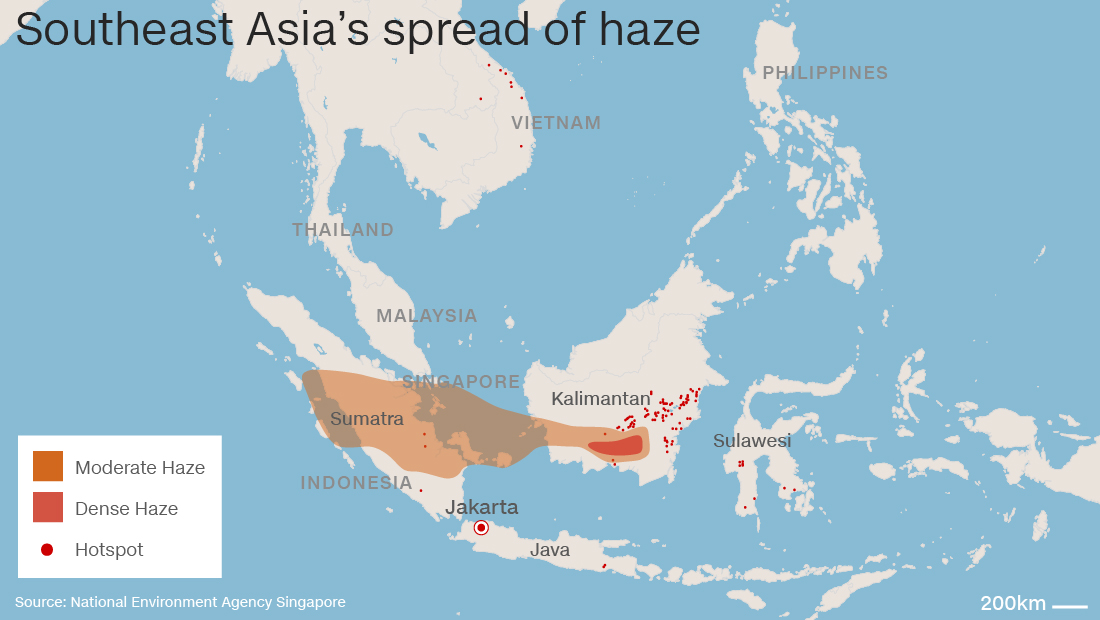
posed by the toxic gases.Air pollution is an environmental problem which is not bound by national boundaries. As shown in the video below, neighbouring countries such as Singapore, Malaysia and the Philippines, are also quite heavily involved due to the spread of the haze.
The structure of the
palm oil supply chain filters down to larger corporations subcontracting to
smaller companies and farmers. To meet the demand for palm oil, forest fires
are started illegally, yet it could be argued that these small scale
stakeholders are acting based upon economic benefit as to them, it outweighs
the environmental cost (Pilloud, 2015). Haze pollution is a yearly occurrence
and an annual air quality problem - what is being done about it? Who enforces
the regulations put in place to penalise those who contribute to the haze?
Whilst the Indonesian
Meterology, Climatology and Geophysics Agency (BMKG) might be portraying the haze as a "crime against
humanity", but for the most part, the Indonesian government has turned a blind eye to the activities of companies in the peatlands. We need to consider who is responsible, and whether they are doing
anything to help alleviate this environmental disaster?
Apologies for the
delay in uploading my second post! It seems that there is not much of a
correlation between the creators of the environmental problem and the people
who are most affected. I'll leave that with you to think about. Until next
time!